

The First Exposure: A History of Nude Photography's Pioneers (1840–1910)
In the moral climate of the nineteenth century, the nude was a paradox. Painting and sculpture could present it as ideal, mythological, safely distant. The camera could not. Photography was too literal, too fast, too obviously made from a real person standing in a real room, and that literalness turned an accepted subject into a scandalous one. The first photographers who pointed a lens at the unclothed body were therefore doing something painters had not done for centuries: taking a genuine risk. This is the story of how they worked, what it cost them, and why every photographer of the nude today is still answering the questions they opened.
I write this as a working photographer who teaches the nude in Berlin, which means the arguments below are not settled history to me. Some version of them surfaces at every session I run.
The Artist's Aid: The Nude as Study (1840s–1860s)
The history of nude photography did not begin as art. It began as a service to art. Painters and sculptors needed anatomical truth, and the new medium could supply it with an accuracy no sketch could match, at a fraction of the cost of keeping a model posed for days. These studies, the études d'après nature, were tolerated because they had an alibi: they existed for someone else's easel.
Paris even regulated the trade. A nude study registered with the state depository could be sold openly to artists; the same image, unregistered and folded into a coat pocket, could send its maker to court. The line between art and obscenity was, from the very first decade, an administrative one. It has never fully stopped being that.
Eugène Durieu (1800–1874): The Collaborative Study
Durieu, a lawyer by training, produced the most consequential studies of the period in direct collaboration with Eugène Delacroix. The painter posed the models himself; Durieu operated the camera; Delacroix then worked from the prints. Look at the image below and you can see the negotiation happening inside a single frame. The pose is pure academy: the standing figure from the back, the strong S-curve, the theatrical fall of light. The rendering is pure photography: actual skin, actual weight, nothing smoothed toward an ideal. Painting asked for a goddess and the camera delivered a woman, and the tension between those two facts is where this genre begins.
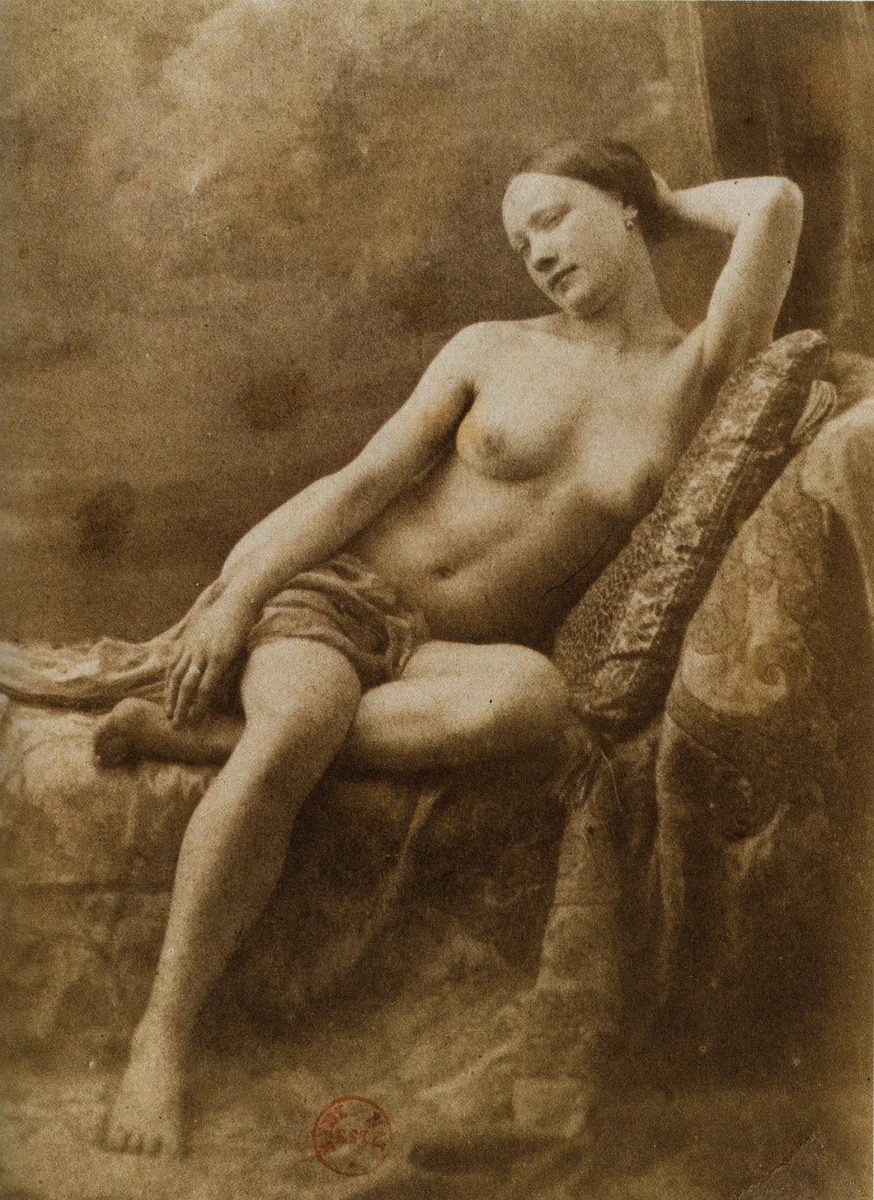
Eugène Durieu, study for Eugène Delacroix, c. 1854
Félix-Jacques Moulin (1802–1875): Testing the Limits
Moulin worked the other side of the same street. His stereoscopic daguerreotypes borrowed the reclining vocabulary of academic painting, but the direct gaze and the contemporary bedroom setting stripped away the alibi. In 1851 a court decided the results were obscene and sent him briefly to prison. He returned to the trade, later fully licensed, and his career makes a point that still holds: the legal history of this genre was written not by theorists but by photographers who found out where the line was by standing on it.
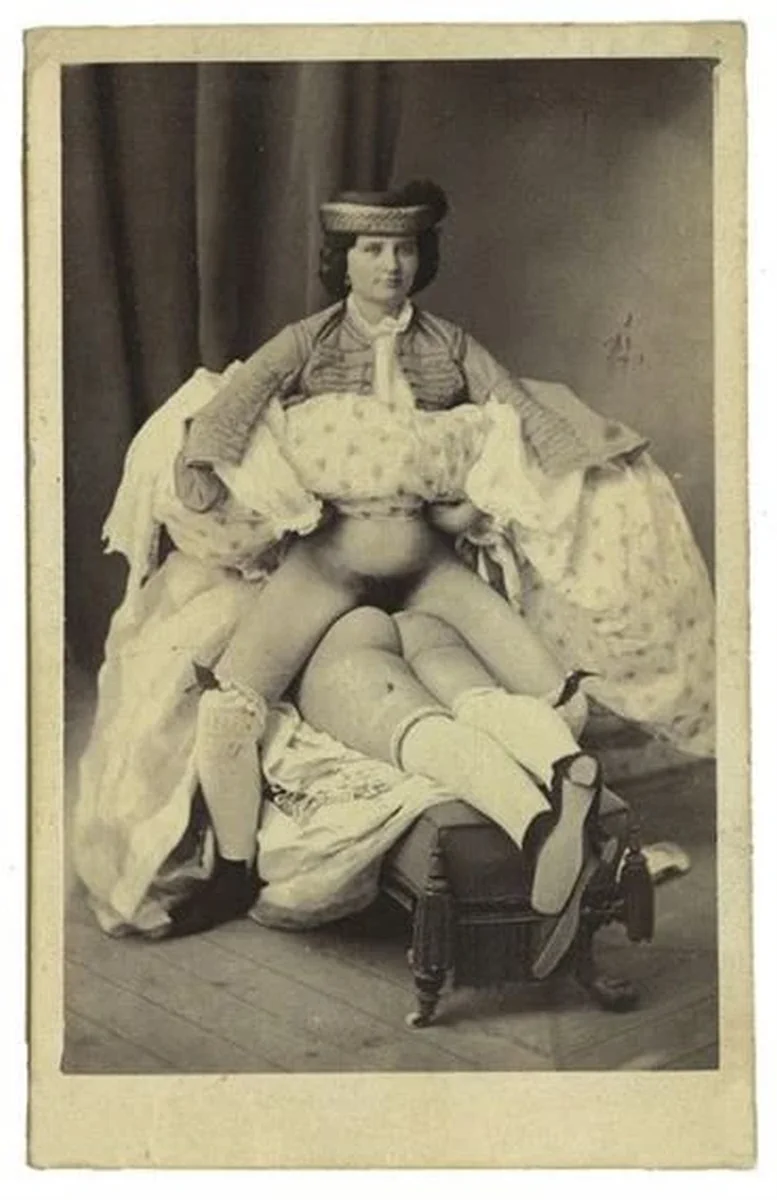
Félix-Jacques Moulin, stereoscopic daguerreotype, 1850s
The Moral Battlefield: Censorship and Allegory (1850s–1880s)
As the genre grew, so did the opposition, and photographers developed a defensive repertoire. The most durable move was borrowed from painting: wrap the nude in mythology, drapery or moral narrative, and let the classical reference argue for you.
Bruno Braquehais (1823–1875): The Classical Alibi
Braquehais, a deaf photographer who later documented the Paris Commune, produced académies that show the strategy at its most transparent. The model holds drapery she does not need, the pose is contained and formal, the backdrop is a studio void. Every element announces: this is sculpture by other means, not a photograph of a woman. You are not required to believe the announcement. The court, usually, did.
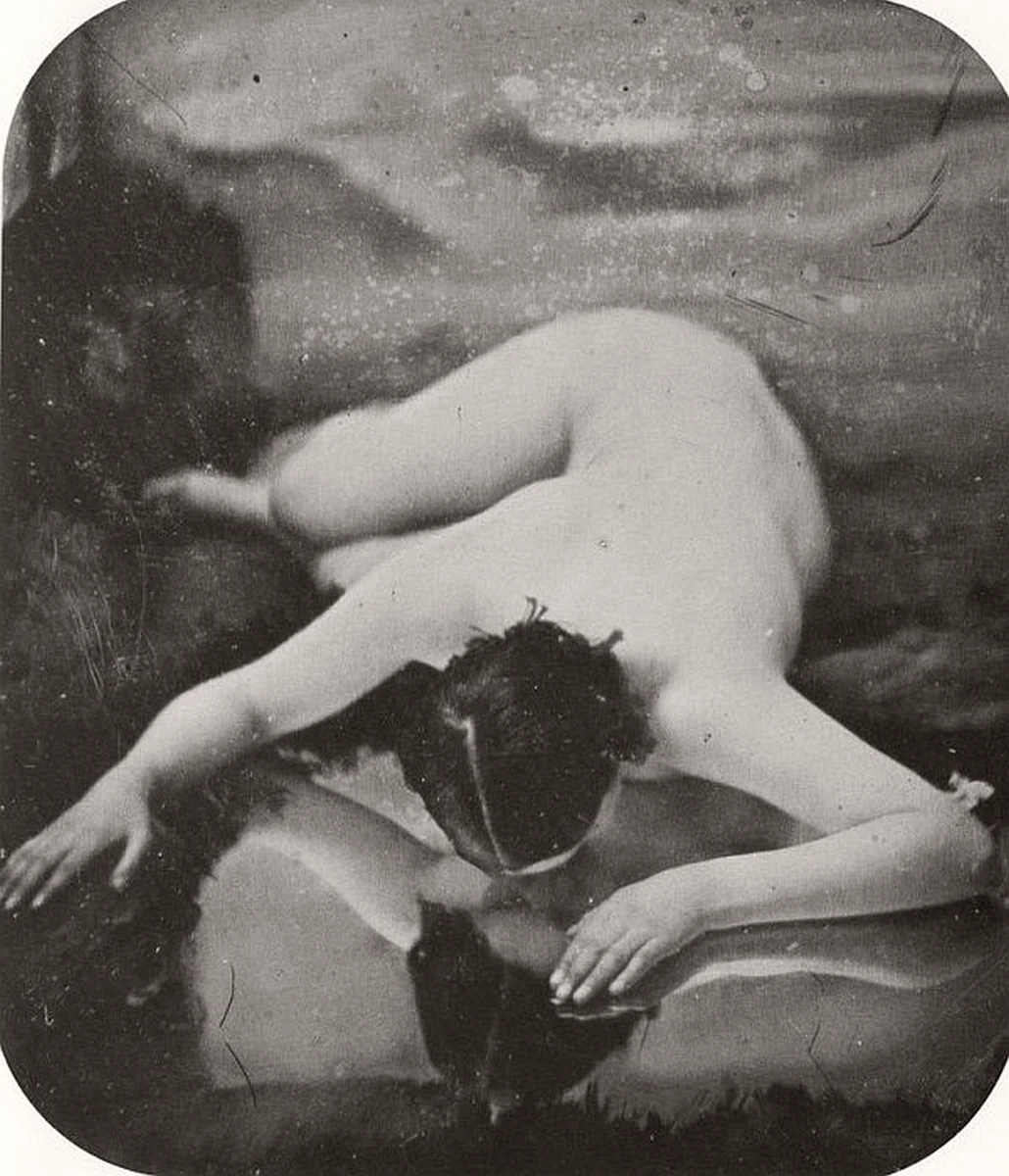
Bruno Braquehais, académie with drapery
Oscar Gustave Rejlander (1813–1875): The Grand Allegory
Rejlander scaled the alibi up to mural size. "The Two Ways of Life" (1857), a composite printed from over thirty negatives, staged a moral allegory of industry versus dissipation and populated the dissipated half with nudes. The scandal was immediate; the rescue came from above, when Queen Victoria bought a print for Prince Albert. A royal receipt did what no manifesto could: it declared, in public, that a photograph containing nudes could be art. Rejlander's gentler work, like the child study below, shows the same Victorian machinery running in reverse, manufacturing innocence with the same theatrical control he used to manufacture sin.
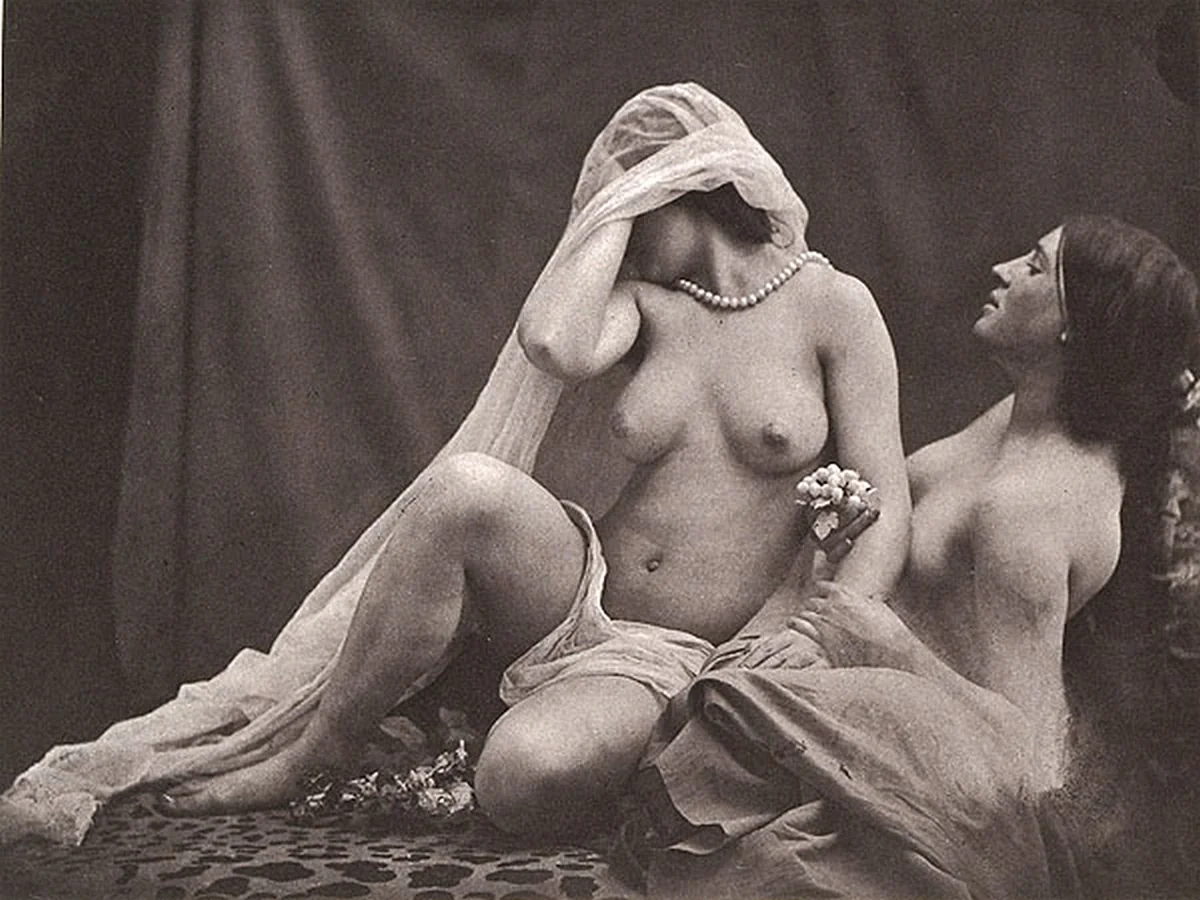
Oscar Gustave Rejlander, child study
Fine-Art Nude Photography Workshops · Since 2012
Join the Workshop List
Nude Art Workshops is a small-group programme founded by photographer and educator Burak Bulut Yıldırım. We run concept-led sessions with professional model collaborators and a maximum of six photographers.
Join the list for new workshop dates, visiting models, new cities, and programme updates. Subscribers usually hear first.
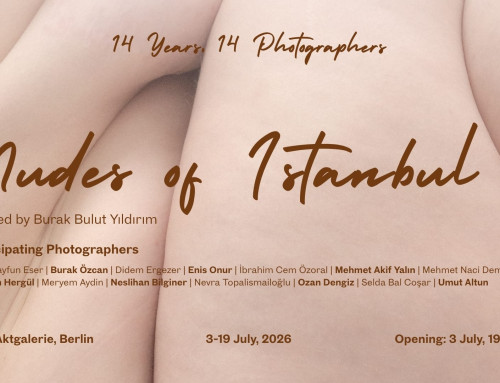
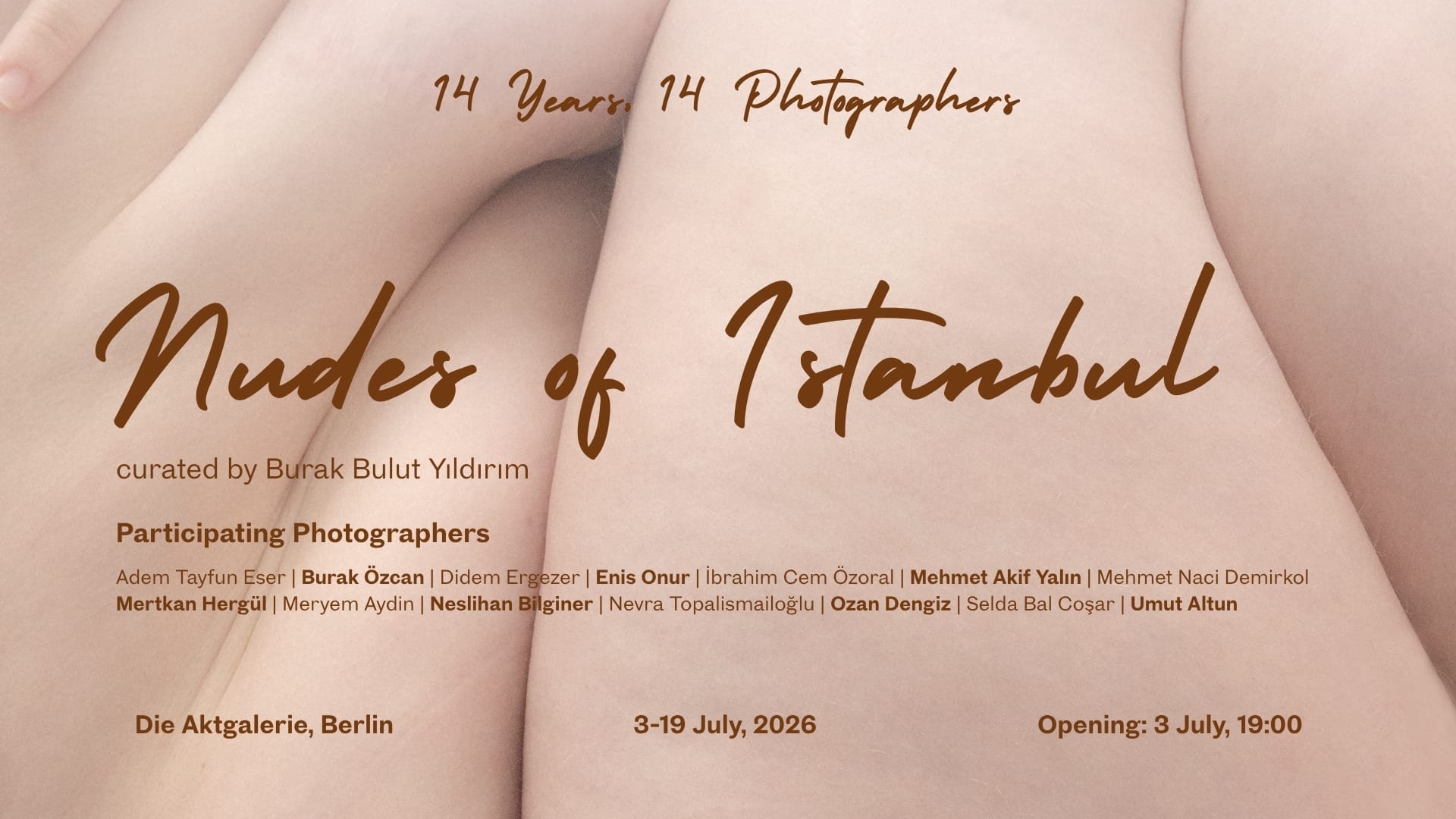
Fourteen years of workshops grew into an exhibition and a hardcover book. The book is now held by the V&A National Art Library in London, Istanbul Modern, the German National Library, and private collectors.
Curious about the project? Discover The Nudes of Istanbul →
Maximum six photographers per session · No weekly sales emails · Instagram: @nudeartworkshops
Parallel Paths: The Analyst and the Dreamer
By the 1880s the genre had split into two temperaments that have never reunited: one treated the body as evidence, the other as escape.
Thomas Eakins (1844–1916): The Analytical Gaze
Eakins photographed the nude the way an anatomist dissects: to know. His motion sequences, made in the same Philadelphia years that Eadweard Muybridge was producing the plates of "Animal Locomotion" at the University of Pennsylvania, are precursors of cinema and documents of a mind that considered the unclothed body a legitimate object of study, full stop. America disagreed. The 1873 Comstock Act had made mailing "obscene" material a federal crime, pushing the nude into private circles, and in 1886 Eakins was forced out of the Pennsylvania Academy after removing a male model's loincloth in front of a mixed class. The photographs survived him; the point they argue, that looking honestly is not a crime, took another century to win.
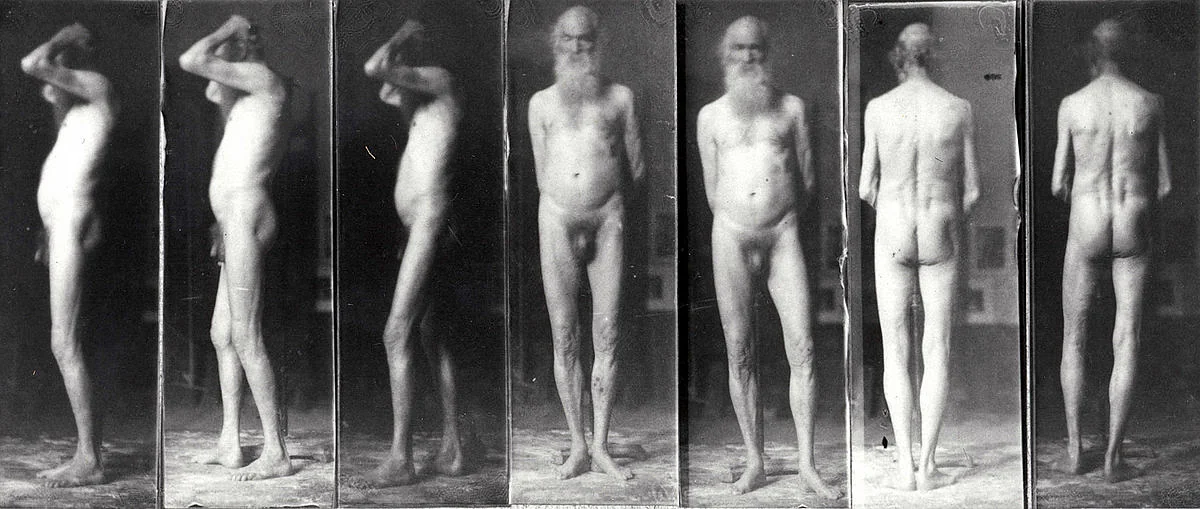
Thomas Eakins, motion study, 1880s
Wilhelm von Gloeden (1856–1931): The Arcadian Dream
In Taormina, von Gloeden built the opposite machine: a fictional antiquity, staged with local Sicilian models, amphoras and laurel crowns, lit by the actual Mediterranean. The homoerotic charge of the work made it contraband in some circles and collectible in others, sometimes the same circles. What matters historically is the method. Von Gloeden proved that photography could construct a world rather than record one, and that the nude could carry longing, not just anatomy. Every staged, art-directed nude made since owes him a technical debt, acknowledged or not.

Wilhelm von Gloeden, Taormina, c. 1900
The Aesthetic Turn: Pictorialism and the Nude as High Art (1880–1910)
The century closed with a coordinated campaign to make photography rank as fine art, and the nude became one of its proving grounds. The Pictorialists blurred, etched and printed their way toward painting, betting that if a photograph looked labored over, it would be read as intended, and intention is what separates a study from a statement.
Julia Margaret Cameron (1815–1879): The Expressive Ground
Cameron photographed few nudes, and the genre still cannot be told without her. Her soft-focus portraits and Pre-Raphaelite allegories established, against loud contemporary mockery, that a photograph could privilege mood over sharpness and feeling over fact. That single permission is the ground the artistic nude stands on. Before anyone could photograph the body as poetry, someone had to prove the camera was allowed to write poetry at all.
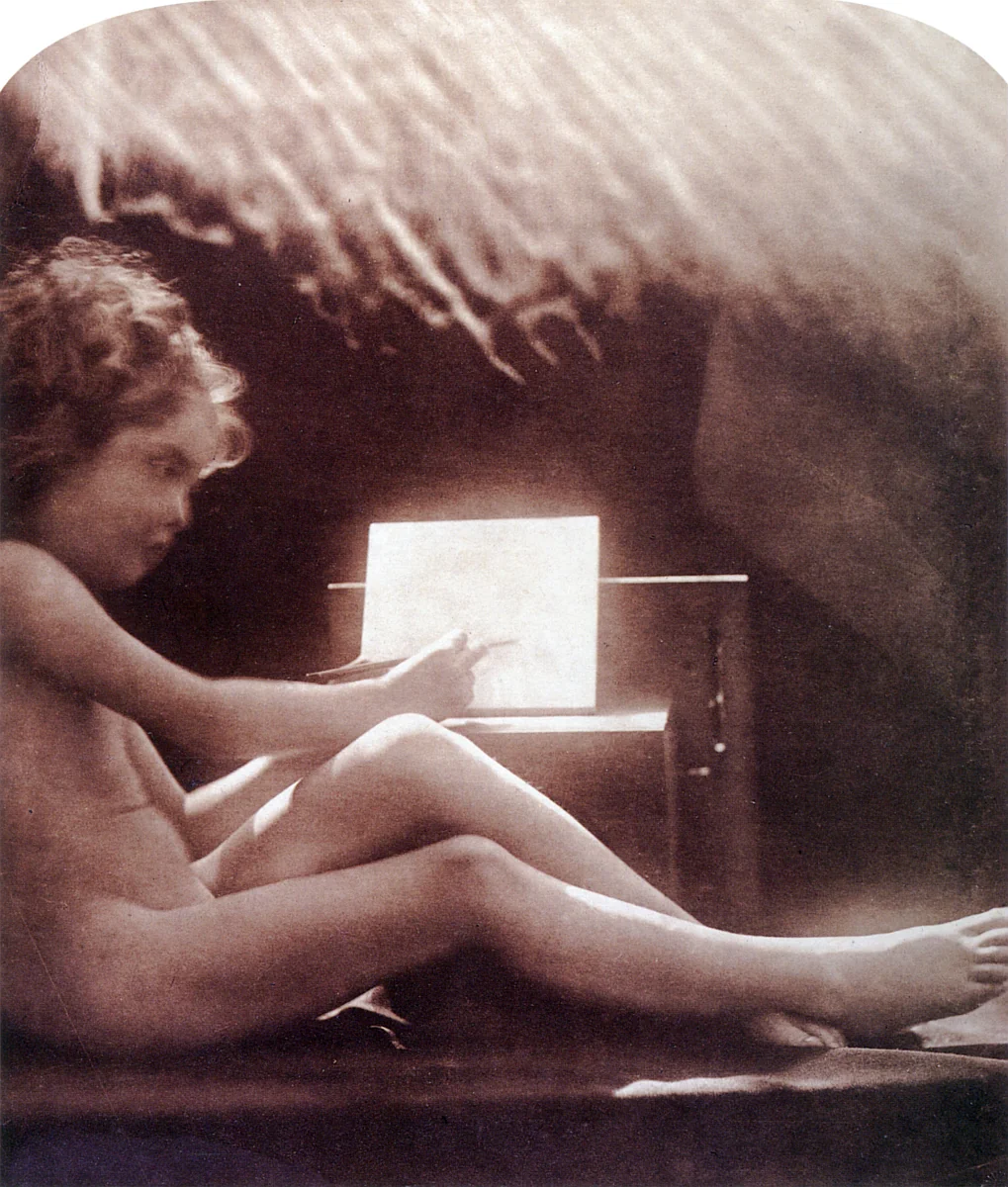
Julia Margaret Cameron, portrait study, 1860s–70s
Fred Holland Day (1864–1933): The Symbolist Vision
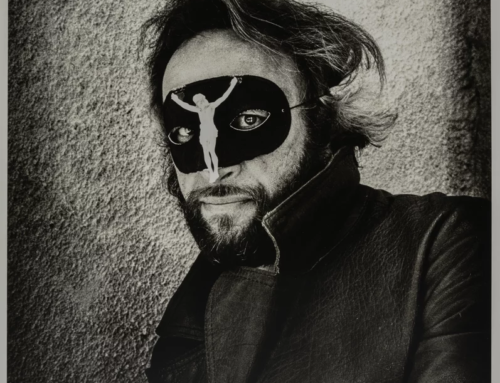
Day pushed the new permission to its limit. His male nudes, staged as religious and mythological scenes and culminating in a series in which he posed as the crucified Christ, fused Symbolist ambition with an openly homoerotic sensibility. Boston society was appalled; the photographs remain some of the most seriously intended images of the era. Day's lesson is about stakes: he treated the nude as a vehicle for the largest subjects he could name, and the work has outlived everyone who found it indecent.
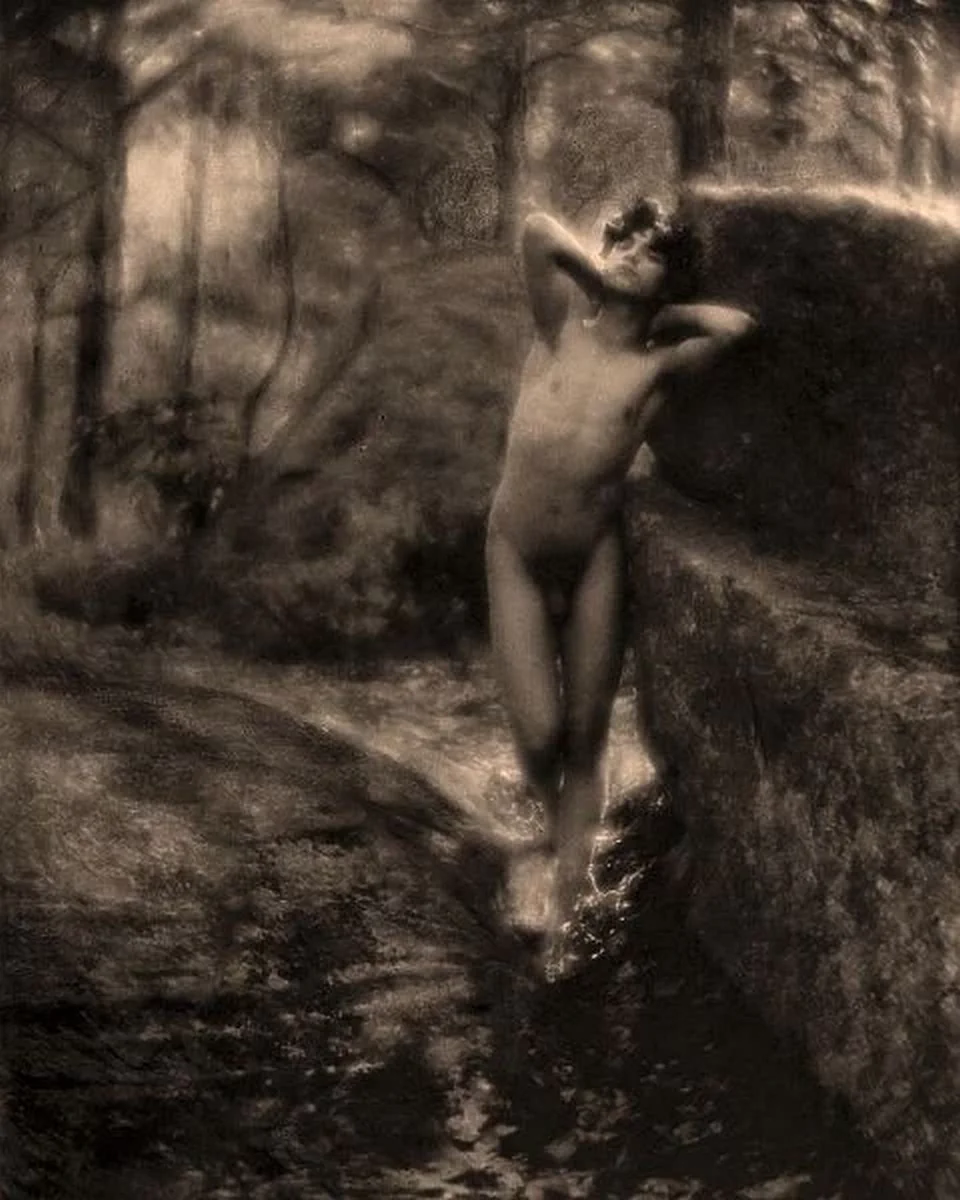
Fred Holland Day, portrait study
Frank Eugene (1865–1936): The Painterly Print
Eugene took Pictorialism to its logical end by attacking the negative itself: scratching, etching and drawing on it until the print sat halfway between photograph and charcoal. The result forces a useful confusion. You cannot look at his nudes as records, because the hand is everywhere; you can only look at them as pictures. In an era that policed photographs of the body far more harshly than drawings of it, that confusion was also a shield.
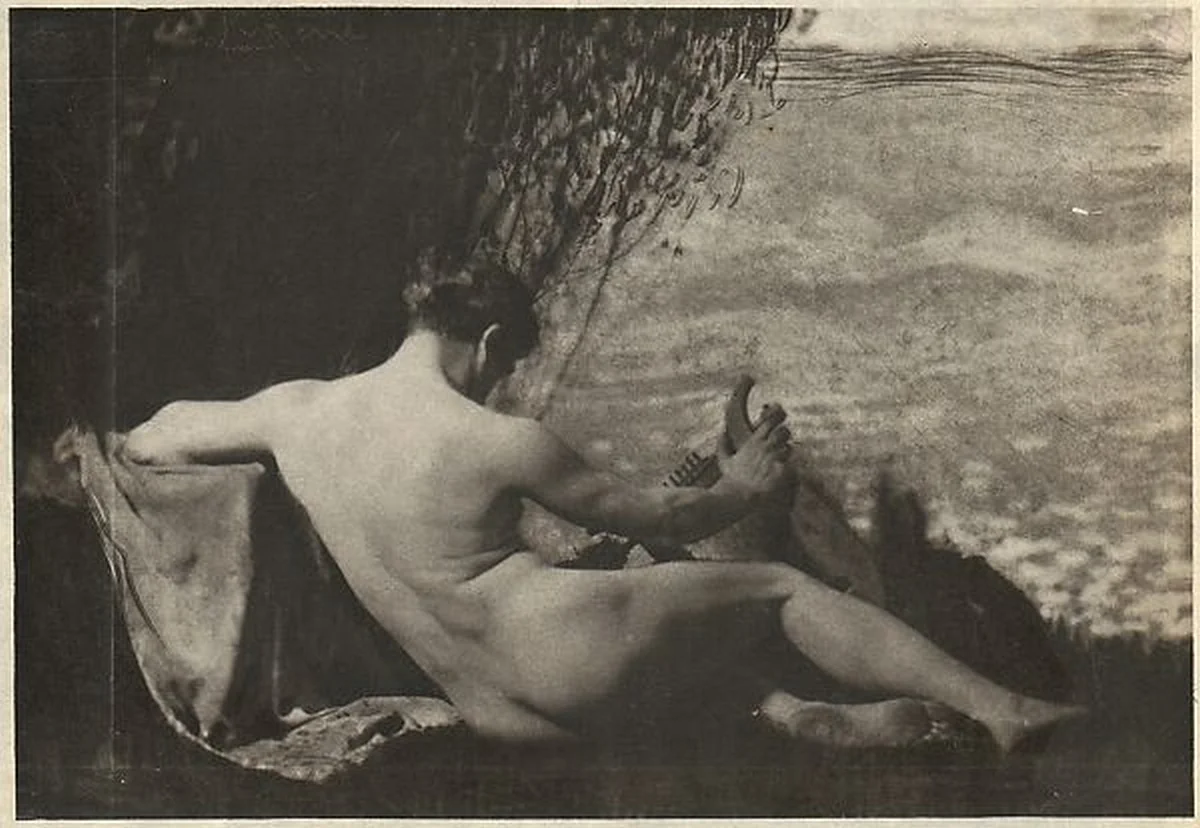
Frank Eugene, manipulated print
Anne Brigman (1869–1950): Both Sides of the Lens
One more pioneer belongs here, and her absence from most tellings of this story is itself part of the story. Anne Brigman, a member of Stieglitz's Photo-Secession, hiked into the Sierra Nevada and photographed her own unclothed body among wind-bent pines and granite, in images like "Soul of the Blasted Pine" (1908). She did something no man in this article could do: she stood on both sides of the lens at once, author and subject, and turned the nude from something taken into something claimed. If you photograph the body today and care about the model's agency in the picture, your lineage runs through her.
The Unbroken Line
Strip away the collodion and the court dates and the pioneers were fighting over four questions. Is a photograph of the body art or document? Should the body be idealized or shown as it is? Who controls the image, the person behind the camera or the person in front of it? And who gets to decide what the public may see? Not one of these has closed. They have only changed costume: the state depository became the platform algorithm, the académie license became the content policy, and the newest dispute, over images of bodies that no camera ever saw, is the oldest dispute wearing generative clothes. My own answer to that last one has stayed physical: everything in my fine art practice is made in camera, with a real person, real light and real fabric, because the collaboration is the work, not a production step.
Berlin, where I live and teach, is the natural laboratory for continuing the experiment. The city's Freikörperkultur tradition treats the unclothed body as ordinary, which frees a session to be about something more interesting than nudity itself. That is the premise of the workshops I run here and in Istanbul: each edition starts from a concept, the way Durieu started from Delacroix's idea and Day started from scripture, and the photographs follow the idea rather than the other way around. The pioneers earned this genre its right to exist. What we owe them is to keep making it mean something.

Into the Wild — Burak Bulut Yıldırım
Questions photographers ask
Who made the first nude photographs?
Nude daguerreotypes appeared within a few years of photography's 1839 announcement, mostly in Paris as studies for painters. Durieu's collaboration with Delacroix in the early 1850s is the earliest sustained, documented artistic project in the genre.
When did nude photography become accepted as art?
Slowly and never completely. Queen Victoria's 1857 purchase of Rejlander's composite was an early legitimizing shock; the Pictorialists around 1900 won institutional ground; museums followed in the twentieth century. Platform-era censorship shows the acceptance is still conditional.
What is an académie?
A nude study made for artists' use, from the French academic tradition. In 1850s Paris the term also marked a legal category: registered académies could be sold openly, while unregistered nudes risked obscenity prosecution.
Where can I study the artistic nude in practice today?
Work with photographers who teach it as a conceptual discipline rather than a glamour format. Our Berlin and Istanbul workshops are built exactly on the questions this article traces, with the model as collaborator and the concept, not the nudity, as the subject. Related reading on this site: posing as a somatic language and lighting the nude.
These workshops are not glamour sessions. Every edition is built on a concept, and sexuality is deliberately demoted to third or fourth place, behind theme, form and the photographer–model collaboration; participants leave with images that belong to an idea. The workshops have run for over fourteen years across more than fifty editions with over three hundred photographers, led by Burak Bulut Yıldırım, a Berlin-based photographer and curator practicing since 2005, exhibited in Berlin, Zurich, Barcelona, Rome, Thessaloniki and Heilbronn, and curator of Nudes of Istanbul (Die Akt Galerie Berlin, 2026; hardcover by Mijuk Papers Berlin).
Portfolio: burakbulut.org · Limited editions on Saatchi Art and Artsper · Contact: hello@nudeartworkshops.com