

A History of Nude Art Photography: 160 Artists Who Changed the Body in Pictures
Every history of nude photography is also a history of power: who was permitted to look, who was required to be looked at, who controlled the negative, and which bodies institutions agreed to call art. Since the camera’s invention, the unclothed body has been used as anatomical evidence, private fantasy, formal experiment, political weapon, commercial bait, personal diary, and a declaration of ownership over one’s own image. This article follows that argument from the 1840s to the present through the movements that changed the genre and a chronological list of 160 photographers and artists who expanded, unsettled, commercialised, politicised, or reinvented it.
I write this as a Berlin-based photographer and educator who teaches the history and practice of nude art photography. The names below are not distant museum furniture to me; their unresolved questions still enter the studio every time a model and photographer decide what the body will mean.
My position is direct: the nude is never neutral. Even the most abstract torso carries assumptions about beauty, gender, class, race, age, desire, and permission. Good photographs do not escape those pressures. They make them visible.
The Painter's Shadow: Early Pioneers and the Academic Nude (1840–1910)
The history of nude photography begins in the mid-19th century inside a convenient fiction: photographs of unclothed models were supposedly technical aids for painters rather than autonomous images. Eugène Durieu (1800–1874), Félix-Jacques Moulin (1802–1875), Gaudenzio Marconi (1841–1885), and others produced académies, carefully posed studies sold through a regulated Parisian trade. The camera offered anatomical detail more efficiently than a live sitting, but it also created something painting could avoid: the stubborn evidence that a real person had stood naked before a machine.
Photography did not invent the nude. It exposed art’s double standard. A painted Venus could hang in a respectable salon, while a photograph using the same pose could be seized as obscenity because the viewer could no longer pretend the body belonged only to mythology. The scandal was not nudity by itself. It was the photograph’s proximity to an actual encounter.
Bruno Braquehais (1823–1875) exemplifies this tension. The model’s formal pose, column, drapery, and controlled profile borrow the language of antiquity to discipline the camera’s realism. The image tries to say “academy” before the viewer can say “desire.”

Bruno Braquehais
By the end of the century, Pictorialists such as Fred Holland Day (1864–1933) used soft focus, controlled printing, and historical staging to claim photography as a fine art. Anne Brigman (1869–1950) made a more radical move: she photographed her own nude body in the Sierra Nevada, turning the woman in the frame from a hired academic model into the author of the image. That shift from object to author would take most of the next century to fully register. The period receives a closer treatment in the history of nude photography’s earliest pioneers.
Breaking the Form: The Modernist Revolution (1920–1960)
Modernism stopped asking whether photography could imitate respectable art and began asking what only a camera could do. Cropping, solarisation, unusual viewpoints, sharp focus, multiple exposure, and optical distortion broke the body into a new visual grammar. Man Ray (1890–1976) made skin look metallic and unstable. Bill Brandt (1904–1983) used wide-angle lenses to turn rooms, limbs, and shorelines into one continuous architecture. Edward Weston (1886–1958) pushed flesh toward sculpture without allowing it to become bloodless.
Imogen Cunningham (1883–1976) was central to the change. Her photographs isolate backs, arms, torsos, and pregnant forms until anatomy becomes geometry, yet the body never loses its physical weight. The modernist nude’s great achievement was not abstraction alone. It proved that abstraction could intensify embodiment rather than erase it.

Imogen Cunningham
When I teach abstraction, I do not begin by telling photographers to hide the face or crop randomly. I ask them to decide what the body is becoming: architecture, rhythm, pressure, landscape, or a field of light. Once that verb is clear, cropping becomes an argument rather than an effect. The same transformation is traced in the expanded guide to the modernist nude.
The Commercial Gaze: Fashion, Glamour, and Revolution (1950s–1970s)
Mass magazines changed the nude as decisively as any avant-garde manifesto. Vogue, Harper’s Bazaar, Playboy, perfume campaigns, record sleeves, and fashion books gave photographers large audiences, production budgets, and a new task: make desire circulate. The nude moved from the private portfolio and specialist gallery into commercial culture, where provocation could be sold as sophistication.
Helmut Newton (1920–2004) fused couture, voyeurism, dominance, and luxury into photographs that still feel like evidence from an expensive crime scene. Richard Avedon (1923–2004) used a very different method, stripping the studio toward white space and confrontation. Sam Haskins (1926–2009) brought graphic sequencing, wit, and the photo-book into the genre. His Cowboy Kate & Other Stories demonstrated that a nude series could behave like cinema on paper.

Sam Haskins
This era made glamour culturally powerful, but it also standardised youth, thinness, whiteness, and female availability as visual currency. Its photographs can be seductive and politically compromised at the same time. That contradiction is not a reason to flatten the work into a moral verdict. It is the reason the work remains worth arguing with.
The Body Politic: Identity, Censorship, and the Contemporary Nude (1970s–Present)
From the 1970s onward, the body became an explicit battleground. Feminist artists, queer photographers, artists of colour, disabled artists, self-portraitists, and diarists challenged the inherited agreement that the nude existed primarily for a detached viewer. The question shifted from “Is this body beautiful?” to “Who controls its meaning, and who is threatened when it looks back?”
Robert Mapplethorpe (1946–1989) became a defining figure in the American culture wars. The cancellation of his 1989 Corcoran Gallery exhibition and the 1990 obscenity trial of Cincinnati’s Contemporary Arts Center turned formal black-and-white photographs into a national argument about sexuality, public funding, and censorship. The prosecution failed, but the conflict revealed how quickly institutions abandon aesthetic neutrality when queer bodies claim monumentality.

Robert Mapplethorpe
Nan Goldin (1953–) made intimacy diaristic and unstable. Sally Mann (1951–) turned family, mortality, and the maternal gaze into public controversy. Rotimi Fani-Kayode, Laura Aguilar, Zanele Muholi, Sunil Gupta, and many others made race, queerness, migration, fatness, disability, and self-representation impossible to treat as side chapters. The contemporary nude is not one style. It is the collapse of the old permission structure. The political sequence is examined in the history of nude photography since 1970.
The Digital Revolution: Access, Manipulation, and Platform Censorship
Digital photography and the internet lowered the cost of production and distribution, allowing artists to bypass magazines, publishers, and galleries. That freedom was real, but incomplete. The gatekeepers did not disappear; they became platforms, algorithms, payment processors, and opaque moderation systems. Nude photography can now reach a global audience in minutes and be erased from that audience just as quickly.
David LaChapelle (1963–) used digital compositing, saturated colour, celebrity, religious iconography, and consumer spectacle to construct theatrical worlds that could not have existed as documentary scenes. His work treats artificiality as the subject rather than a defect.

David LaChapelle
Nobuyoshi Araki (1940–) represents another route through modern image culture: prolific, diaristic, intimate, and permanently controversial. His snapshot-like I-Photography binds sex, grief, domestic life, bondage, flowers, and Tokyo into one continuous autobiography. The work cannot be separated from arguments about misogyny and power, and it should not be. Historical importance is not moral innocence.

Nobuyoshi Araki
Nude Art Workshops · Berlin & Istanbul
History becomes useful when you can test it with a camera. Each workshop edition begins with a concept and a visual problem; sexuality is deliberately pushed behind theme, form, light, and the photographer–model collaboration. The aim is not to imitate a famous nude, but to understand the decision that made it unavoidable.
The Camera in Her Hands: Women Rewriting the Nude
Women photographers did more than add a female viewpoint to an existing genre. They changed the genre’s central transaction. Imogen Cunningham claimed formal authorship; Anne Brigman placed her own body before her own camera; Diane Arbus refused glamour; Francesca Woodman made disappearance a form of self-portraiture; Cindy Sherman exposed femininity as a performed script; Sally Mann reversed the traditional direction of vulnerability; Zanele Muholi turned self-representation into visual activism.
The “male gaze” remains useful because it names a system, not because every man looks identically or every woman automatically escapes objectification. What changed was authorship. The body in the photograph could now be the maker, collaborator, witness, and critic of the image rather than its silent material. That reversal is developed in the history of women who redefined nude photography.
In my own studio practice, the model is never treated as raw material waiting for a photographer’s idea. The image is negotiated through direction, refusal, adjustment, and review. This does not weaken authorship. It gives the photograph more intelligence than one person could impose on it.
The Future of Nude Art Photography: Recorded Bodies or Invented Ones?
Generative AI, virtual production, volumetric capture, and synthetic bodies are already changing visual culture. They will produce convincing images of bodies that never stood before a camera and encounters that never occurred. This does not make physical photography obsolete. It makes its defining condition newly visible: a photograph of a real body records that something happened between people, light, time, and a place.
AI is not automatically the future of photography. It is the pressure that forces photography to state what it values. My fine-art work is built through physical, in-camera techniques rather than generative image-making because friction matters: fabric resists, bodies tire, light misses, consent changes, accidents become form. A synthetic body may be visually persuasive, but it cannot replace the ethical and psychological event of photographing someone who can answer back.
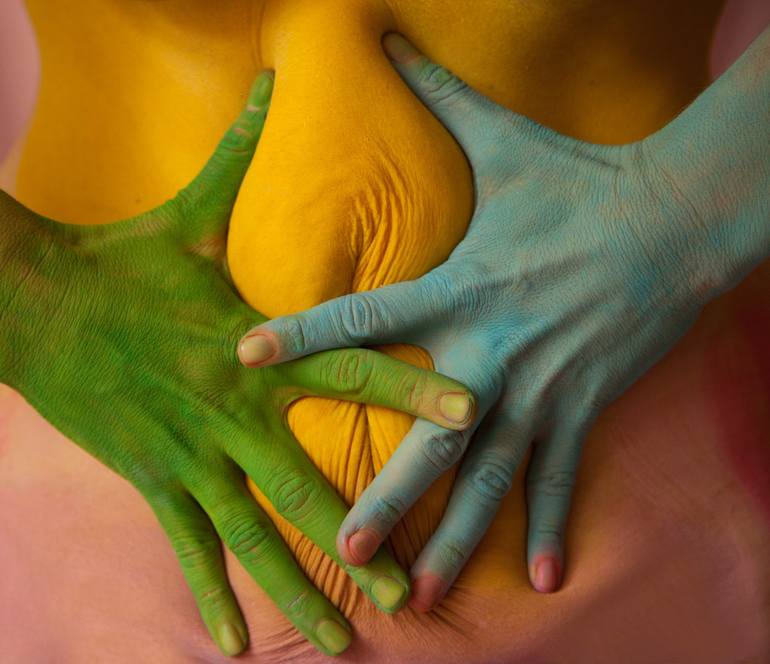
The body imagined as a post-human interface
The next decisive movement may not be a style at all. It may be a renewed insistence on provenance: who made the body, who consented to its use, what was physically photographed, what was generated, and whether the viewer is being invited into an encounter or merely shown a plausible surface.
How to Read a Canon of 160 Artists
No list of influential photographers is innocent. Canons are built through museums, publishers, markets, censorship battles, access to models, critical fashion, and repetition. Some names below belong to fine art; others entered the history through fashion, erotica, documentary work, publishing, scandal, or technical influence. Inclusion records impact. It is not an endorsement of every image, working method, or personal history.
The original version of this article promised 160 artists but contained 158 names. Anne Brigman and Zanele Muholi have been added because a history that excludes self-authored female nudity at the birth of modernism and Black queer self-representation in the contemporary period does more than leave a gap. It tells the wrong story.
160 Pioneering Nude Art Photographers and Artists
1–40 · Foundations, Pictorialism, and Modernism
- Eugène Durieu (1800-1874)
- Félix-Jacques Moulin (1802-1875)
- Bruno Braquehais (1823-1875)
- Gaudenzio Marconi (1841-1885)
- Wilhelm von Gloeden (1856-1931)
- Fred Holland Day (1864-1933)
- Anne Brigman (1869-1950)
- Karl Blossfeldt (1865-1932)
- Vincenzo Galdi (1871-1961)
- Selma Genthe (1873-1950)
- Ernest J. Bellocq (1873-1949)
- Jean Agélou (1878-1921)
- Gerhard Riebicke (1878-1957)
- Magnus Weidemann (1880-1967)
- Friedrich Seidenstücker (1882-1966)
- Imogen Cunningham (1883-1976)
- Lotte Herrlich (1883-1956)
- Hermann Schieberth (1883-1948)
- Rudolf Koppitz (1884-1936)
- Edward Weston (1886-1958)
- Albert Arthur Allen (1886-1962)
- Man Ray (1890-1976)
- Florence Henri (1893-1982)
- Josef Breitenbach (1896-1984)
- Brassaï (1899-1984)
- Yva (1900-1942)
- Wynn Bullock (1902-1975)
- Herbert List (1903-1975)
- Bill Brandt (1904-1983)
- Ruth Bernhard (1905-2006)
- Horst P. Horst (1906-1999)
- Philippe Halsman (1906-1979)
- George Platt Lynes (1907-1955)
- Andre de Dienes (1913-1985)
- Konrad Helbig (1917-1986)
- Helmut Newton (1920-2004)
- Francesco Scavullo (1921-2004)
- Milton Greene (1922-1985)
- Diane Arbus (1923-1971)
- Richard Avedon (1923-2004)
41–80 · Post-war Bodies, Editorial Culture, and Counterculture
- Herbert Tobias (1924-1982)
- Sam Haskins (1926-2009)
- Günter Rössler (1926-2012)
- Garry Winogrand (1928-1984)
- Guy Bourdin (1928-1991)
- Charlotte March (1929-2005)
- George Dureau (1930-2014)
- Bunny Yeager (1930-2014)
- Bob Guccione (1930-2010)
- Eikoh Hosoe (1933-2024)
- David Hamilton (1933-2016)
- Jeanloup Sieff (1933-2000)
- Douglas Kirkland (1934-2022)
- Lee Friedlander (1934-)
- Günter Gueffroy (1944-2015)
- Peter Hujar (1934-1987)
- Jan Saudek (1935-)
- Amos Badertscher (1936-)
- David Bailey (1938-)
- Joel-Peter Witkin (1939-)
- Ralph Gibson (1939-)
- Klaus Ender (1939-2021)
- Nobuyoshi Araki (1940-)
- Kishin Shinoyama (1940-2024)
- Ewald Hoinkis (1897-1960)
- Sarah Moon (1941-)
- Oliviero Toscani (1942-)
- Serge Lutens (1942-)
- Albert Watson (1942-)
- Peter Berlin (1942-)
- Dianora Niccolini (1942-)
- Larry Clark (1943-)
- Guy Le Baube (1944-)
- Sebastião Salgado (1944-2025)
- Robert Farber (1944-)
- Tamara Amhoff-Windeler (1945-2013)
- Eric Kroll (1946-)
- John Swannell (1946-)
- Bruce Weber (1946-)
- Robert Mapplethorpe (1946-1989)
81–120 · Identity, Fashion, Performance, and the Expanded Nude
- Suze Randall (1946-)
- Paolo Roversi (1947-)
- Dominique Isserman (1947-)
- James Nachtwey (1948-)
- Laurie Simmons (1949-)
- Lois Greenfield (1949-)
- Sally Mann (1951-)
- Alain Daussin (1951-)
- Herb Ritts (1952-2002)
- Nan Goldin (1953-)
- John Sexton (1953-)
- Michael Kenna (1953-)
- Klaus Mitteldorf (1953-)
- Cindy Sherman (1954-)
- Steven Meisel (1954-)
- Annie Sprinkle (1954-)
- Michael Thompson (1954-)
- David Armstrong (1954-2014)
- Richard Kern (1954-)
- Matthew Rolston (1955-)
- Andreas Gursky (1955-)
- Anton Corbijn (1955-)
- Sante D’Orazio (1956-)
- Gilles Berquet (1956-)
- Prabuddha Dasgupta (1956-2012)
- Marc Lagrange (1957-2015)
- Peter Klashorst (1957-2024)
- Ingo Taubhorn (1957-)
- Thomas Karsten (1958-)
- Francesca Woodman (1958-1981)
- Rineke Dijkstra (1959-)
- Dahmane (1959-)
- Tono Stano (1960-)
- Helene Schmitz (1960-)
- Gabriele Viertel (1960-)
- Peter Coulson (1961-)
- Vinoodh Matadin (1961-)
- Nadav Kander (1961-)
- Henning von Berg (1961-)
- Vince Lussa (1961-)
121–160 · Contemporary, Global, and Digitally Mediated Practice
- Michael Sonntag (1961-)
- Corinne Day (1962-2010)
- Gregory Crewdson (1962-)
- Bettina Rance (1962-)
- David LaChapelle (1963-)
- Inez van Lamsweerde (1963-)
- Marc Collins (1963-)
- Olaf Martens (1963-)
- Tom Munro (1964-)
- Juergen Teller (1964-)
- Dani Fehr (1964-)
- Andreas H. Bitesnich (1964-)
- Terry Richardson (1965-)
- Karl Vanselow (1965-)
- Jean-Baptiste Huynh (1966-)
- David Sims (1966-)
- Rankin (1966-)
- Sylvie Blum (1967-)
- Spencer Tunick (1967-)
- Jens Brüggemann (1967-)
- Jiří Růžek (1967-)
- Platon (1968-)
- Glen Luchford (1968-)
- Manfred Baumann (1968-)
- Dov Charney (1969-)
- Petter Hegre (1969-)
- Henrik Pfeifer (1972-)
- Zanele Muholi (1972-)
- Ron Kuhwede (1972-)
- Bjarne Jonasson (1973-)
- Astrid Susanna Schulz (1974-)
- Yu Tsai (1975-)
- Martin Rehm (1975-)
- Aneta Bartos (1977-)
- Juha Arvid Helminen (1977-)
- Oliver Rath (1978-2016)
- Niels van Roij (1979-)
- Adrian Hamilton (1980-)
- Kingdome 19 (1980-)
- Burak Bulut Yıldırım (1982-)
Questions Photographers Ask
Who made the first nude photographs?
There is no single uncontested first author. Nude daguerreotypes and paper studies appeared soon after photography’s invention, while figures such as Eugène Durieu, Félix-Jacques Moulin, Bruno Braquehais, and Gaudenzio Marconi established the 19th-century academic nude as a recognisable field.
Why include controversial or commercial photographers?
Because influence is not the same as virtue. Fashion magazines, erotic publishing, censorship cases, exploitative practices, and commercial aesthetics all changed how bodies were photographed and circulated. Removing difficult figures would produce a cleaner list and a false history.
Which movements changed nude photography most?
The academic nude established the camera’s claim to the body; modernism broke anatomy into form; fashion industrialised desire; feminist and queer practice challenged the ownership of the gaze; digital distribution globalised access while creating new forms of censorship.
How can I study this history through practice?
Choose one historical problem rather than copying one historical image: abstraction, concealment, confrontation, sequence, self-portraiture, or the politics of looking. Our Berlin and Istanbul nude art workshops build each edition around such a problem, with concept and collaboration taking priority over nudity itself.
The history on this page remains active in our ateliers. Each edition is organised around a concept, not a catalogue of attractive poses; sexuality is placed third or fourth behind the theme, the structure of the image, and the model–photographer collaboration. The workshops are intended for photographers who want to make authored work rather than collect variations of the same nude.
Led by Burak Bulut Yıldırım, Berlin-based photographer, contemporary artist, curator, and educator practicing professionally since 2005: 14+ years of nude art workshops, 50+ editions, 300+ participating photographers, exhibitions in Berlin, Zurich, Barcelona, Rome, Thessaloniki, and Heilbronn, and curator of Nudes of Istanbul at Die Akt Galerie Berlin in 2026, accompanied by a hardcover published by Mijuk Papers Berlin.
See upcoming workshop dates Email us for first access →
Portfolio: burakbulut.org · Limited editions on Saatchi Art and Artsper · Contact: hello@nudeartworkshops.com