
The Glossy Revolution: How Fashion and Glamour Shaped Nude Photography (1950s-1970s)
The period between the 1950s and 1970s was driven by a new, powerful force: consumer culture. The post-war economic boom in the West gave rise to mass-market magazines like Vogue, Harper's Bazaar, and the newly launched Playboy, which wielded unprecedented influence. With huge budgets and vast audiences, these publications became the new patrons of photography, commissioning artists to create images that were not only beautiful but also provocative, aspirational, and, above all, desirable. This dynamic environment made the boundaries between fashion, glamour, and fine art increasingly porous, creating a bold, commercially charged, and unapologetically sexual style of fashion nude photography that defined an era and continues to influence us today.
I approach this history as a photographer who has worked across commercial production and fine art since 2005. The overlap matters because the same lighting or styling device changes meaning when it moves from an editorial commission to an autonomous series. That distinction is part of the concept-led teaching outlined on the Nude Art Workshops homepage.
Gloss was never superficial. It was a technology of authority. Perfect printing, expensive sets and controlled bodies made fantasy look inevitable, and that apparent inevitability is what gave fashion photography its cultural force.
The Cultural Context: A World in Flux
This photographic revolution was driven by post-war wealth, mass magazine circulation and a public appetite for images that looked more liberated than everyday life felt. The contraceptive pill, introduced in the United States in 1960 and spreading through Europe, was one of the decisive catalysts of the sexual revolution: it helped detach sex from compulsory reproduction in the popular imagination. Feminism, queer liberation, censorship battles and advertising money turned that shift into a visual war over who could show desire, who could profit from it and whose body would carry the message.
The Magazine as Patron, Editor, and Distribution System
A magazine commission was never only a photographer and a model. Art directors, fashion editors, stylists, publishers, advertisers and printers determined the scale and sequence in which an image appeared. A contact sheet could become a cover, a double-page spread or a small supporting frame, and each use changed its force.
Reproduction also mattered. High-contrast black and white survived coarse printing differently from subtle tonal work; colour transparency demanded planning around inks and paper stock. The “glossy” look was therefore both an aesthetic and a production system.
Helmut Newton (1920–2004): The Architect of "Porno Chic"
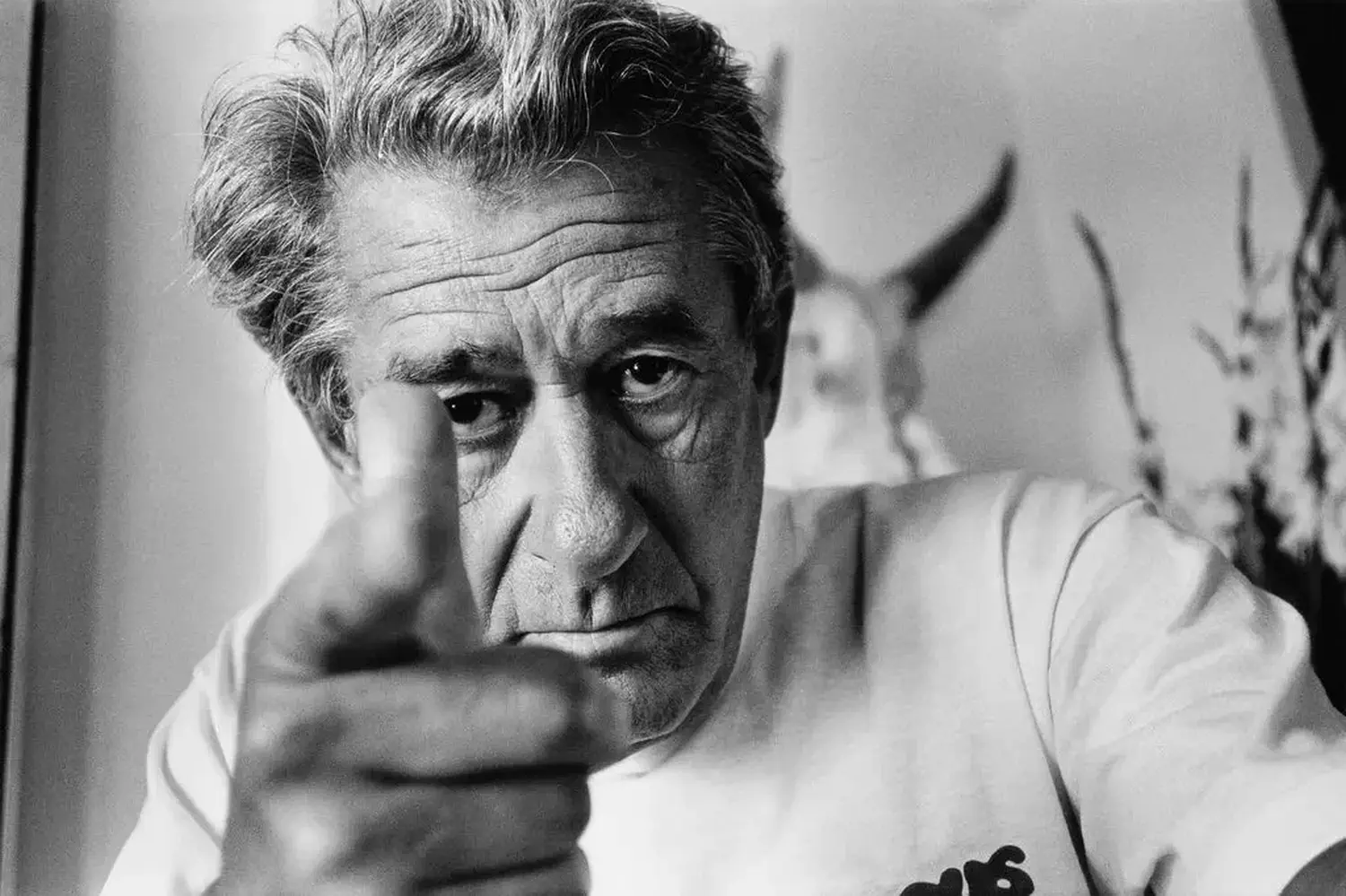
Helmut Newton
No photographer embodied the dangerous glamour of this period more completely than Helmut Newton. He fused couture, voyeurism, luxury, domination and erotic threat into pictures that feel like evidence from a very expensive crime scene. His women are tall, intimidating and Amazonian; they occupy hotels, streets and villas as if they own both the architecture and the viewer. “Porno chic” was not merely frank sexuality with better styling. It was pornography’s power games rebuilt with the budgets and visual authority of high fashion.
The Newtonian Woman: Power, Androgyny, and Voyeurism
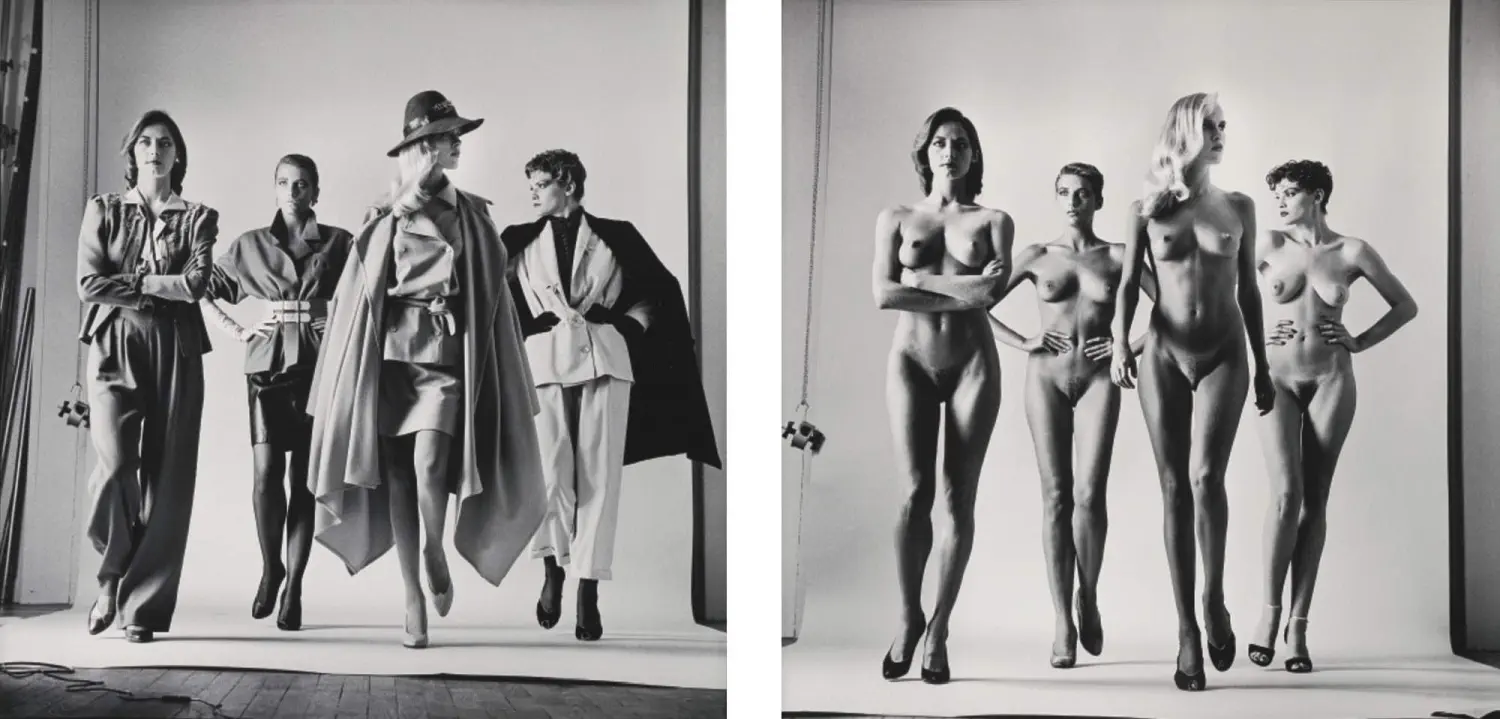
Newton's famous diptych, "Sie Kommen" (They Are Coming, 1981), is a perfect distillation of his philosophy. It directly confronts the relationship between fashion, power, and the body by showing four models walking forward, first fully clothed in power suits, then completely nude. The statement is clear: for Newton's women, clothing and nudity are both uniforms of power. Similarly, his "Big Nudes" series, inspired by the stark aesthetic of German police forensic photographs, presents the female form as monumental and confrontational, transforming the model into a towering icon who stares down the viewer.
Helmut Newton
Both Sie Kommen and the Big Nudes belong to 1981 or the turn of that decade, outside the strict 1950s–1970s range in this title. They are included because they consolidate strategies Newton developed through the earlier magazine era. The distinction matters: these are consequences of the glossy revolution, not evidence from its first phase.
Newton’s women are powerful, and the pictures are objectifying. Both statements can be true at once. That contradiction is exactly why the work still burns: the model appears to dominate the scene while the commission, photographer and viewer continue to organise the terms of looking. The tension is examined from the opposite side in the history of women photographers rewriting the nude.
Richard Avedon (1923–2004): The Minimalist Gaze
Richard Avedon
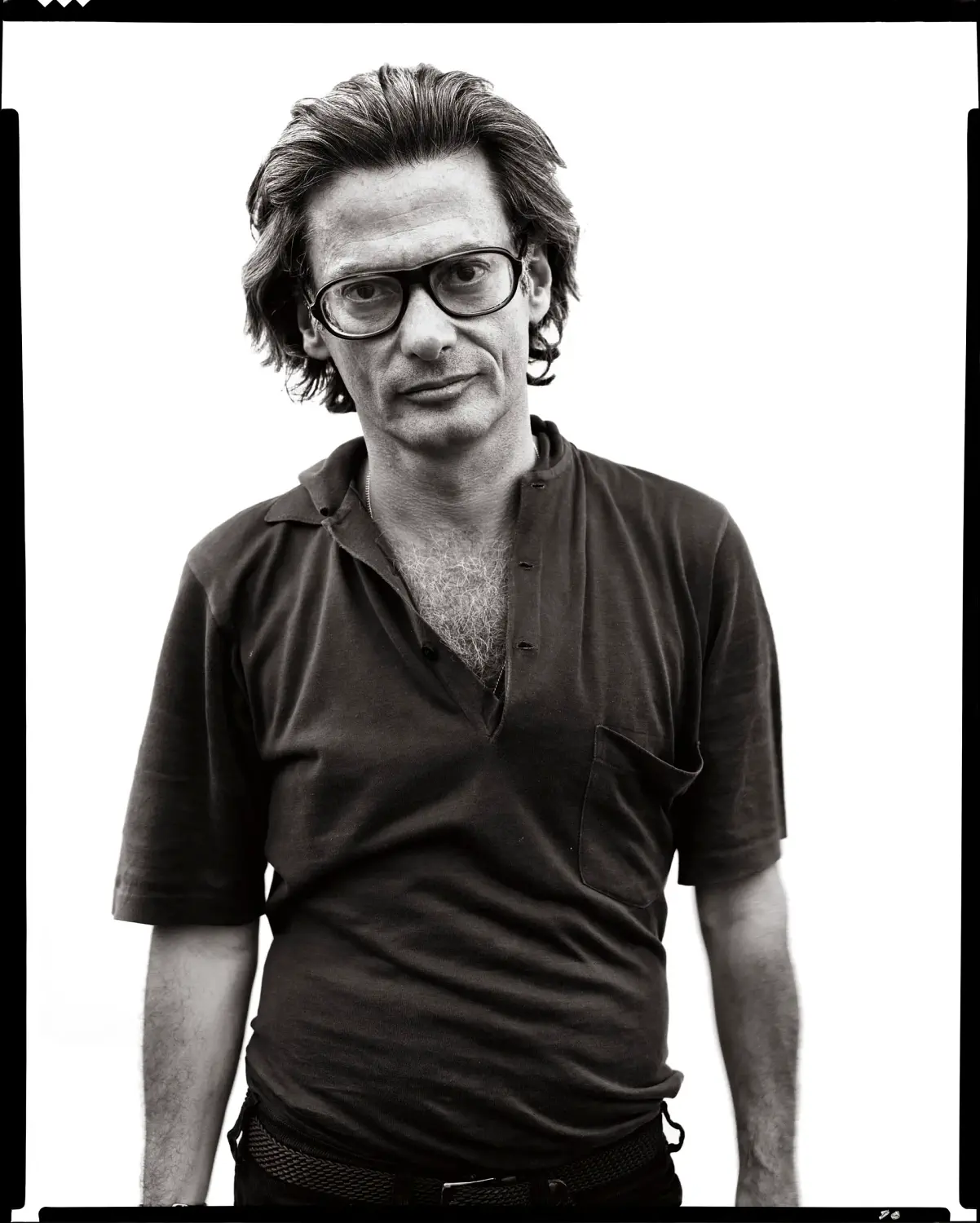
While Newton built cinematic worlds, Richard Avedon stripped them away. Primarily a fashion and portrait photographer, Avedon brought a minimalist power to the nude. Using his signature stark white background, he removed all context, forcing a direct and intimate confrontation between the viewer and the subject. His nudes are less about eroticism and more about revealing the vulnerability, individuality, and essential character of the person before his lens.
The Studio as Laboratory: Character Over Context
Avedon's white background functioned as a psychological canvas. By isolating his subjects from any environment, he believed he could capture a deeper truth about their character. His iconic 1981 photograph, "Nastassja Kinski and the Serpent," perfectly demonstrates this. The coiled snake mirrors and accentuates the curves of Kinski's body, creating a potent symbol of temptation, danger, and primal beauty. It is a record of Avedon's genius that he could create such a rich, mythological narrative using only a body, a prop, and a blank wall.

Richard Avedon
Nastassja Kinski and the Serpent was photographed in 1981, so it also functions here as an after-image of the period rather than a 1970s example. Its economy shows what the preceding decades had established: a fashion publication could fund an image designed to circulate far beyond the garment or issue that commissioned it.
Sam Haskins (1926–2009): The Graphic Innovator
Sam Haskins
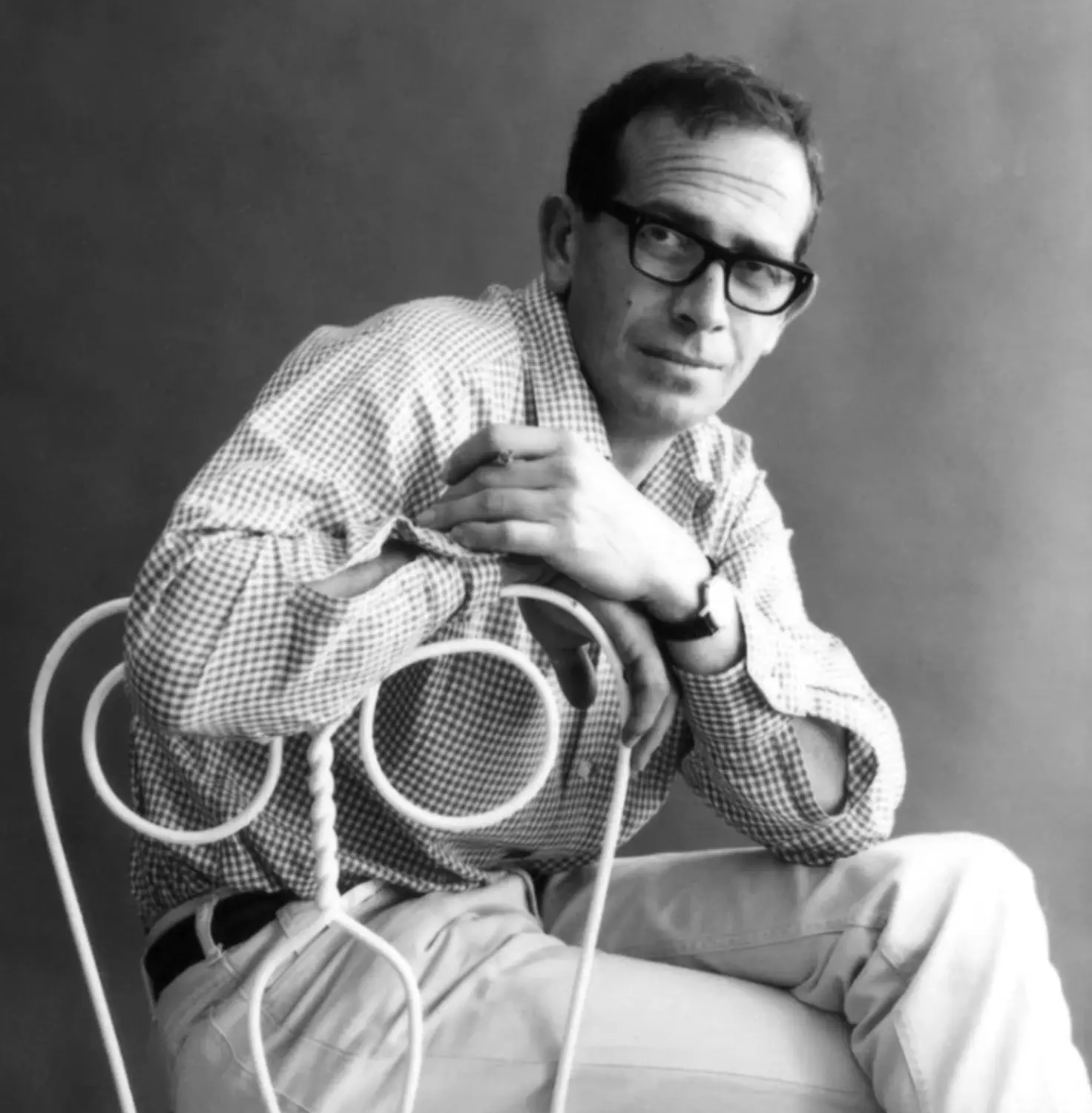
Sam Haskins brought a playful, graphic, and deeply innovative sensibility to the nude. Where Newton was cinematic and Avedon was minimalist, Haskins was a storyteller. His groundbreaking photo books were not only collections of images but narrative photo-novels. He used high-contrast printing, creative cropping, grain, and multiple exposures to create a dynamic and fresh visual style that was a world away from traditional, static nudes.
Beyond the Single Image: The Rise of the Photo-Novel
His celebrated book "Cowboy Kate & Other Stories" (1964) was a pioneering work of sequential visual storytelling that influenced fashion editorials for decades. The image from "November Girl" below, with its playful use of an apple, is characteristic of Haskins's approach: sensual and beautiful, but also witty, charming, and full of a joyful, liberated spirit that perfectly captured the optimism of the 1960s.

Sam Haskins
The difference between the two books is carried by rhythm as much as subject. Cowboy Kate builds a narrative world across pages; November Girl uses props, graphic contrast and episodic play to keep the sequence moving.

Sam Haskins
Haskins's books make sequencing part of the photograph. Repetition, page turns, cropping and graphic rhythm create meaning that no isolated print contains. When you build an editorial series now, the useful question is not only which image is strongest, but which frame changes the meaning of the next one.
Fine-Art Nude Photography Workshops · Since 2012
Join the Workshop List
Nude Art Workshops is a small-group programme founded by photographer and educator Burak Bulut Yıldırım. We run concept-led sessions with professional model collaborators and a maximum of six photographers.
Join the list for new workshop dates, visiting models, new cities, and programme updates. Subscribers usually hear first.
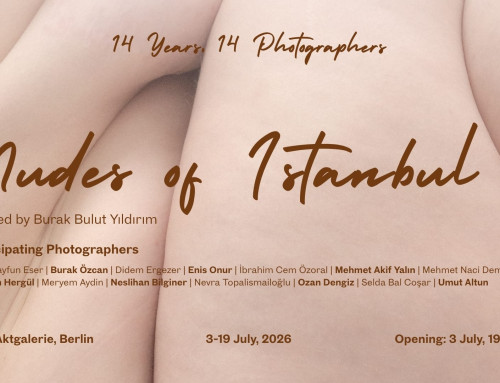
Fourteen years of workshops grew into an exhibition and a hardcover book. The book is now held by the V&A National Art Library in London, Istanbul Modern, the German National Library, and private collectors.
Curious about the project? Discover The Nudes of Istanbul →
Maximum six photographers per session · No weekly sales emails · Instagram: @nudeartworkshops
Chroniclers of an Era: Other Influential Figures
Alongside the major architects, a host of other talented photographers captured and defined the spirit of the age.
Jeanloup Sieff (1933–2000): The Elegant Gaze
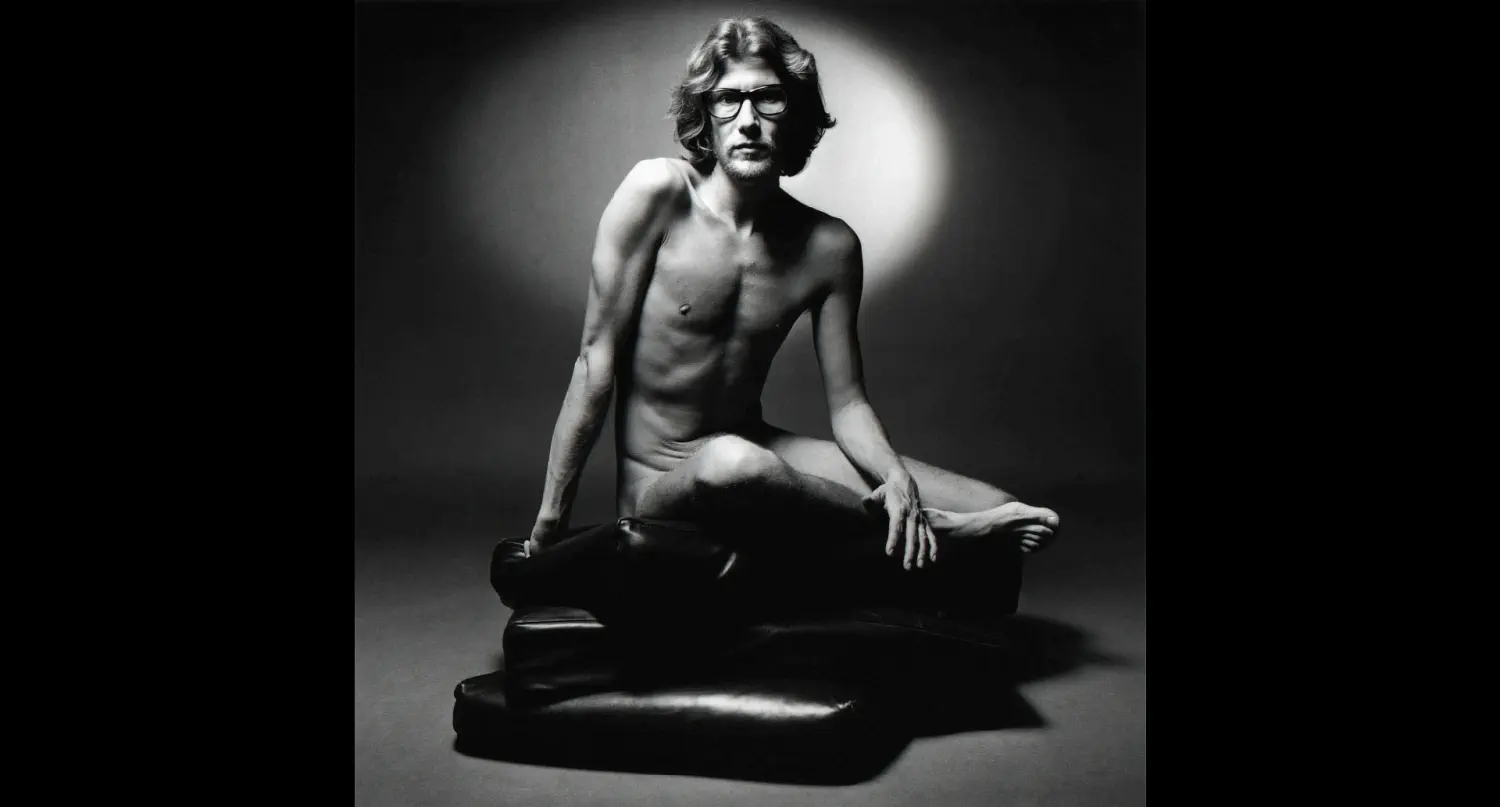
Jeanloup Sieff was known for his elegant, often whimsical, and distinctly European approach. He frequently used wide-angle lenses to elongate and distort the human form, creating graceful and dramatic compositions that played with deep shadows and stark highlights. His powerful and controversial 1971 nude portrait of the fashion designer Yves Saint-Laurent for his own perfume campaign was a landmark moment, challenging gender norms and perfectly merging the worlds of high fashion, celebrity, and fine art.
Jeanloup Sieff
Guy Bourdin (1928–1991): Surrealism, Fetish, and Fatalism
Guy Bourdin met Man Ray early in his career and absorbed Surrealist strategies into a practice that brought a surrealist, provocative, and often unsettling vision to his fashion work for French Vogue and Charles Jourdan shoes. He created complex, mysterious, and richly colored narratives in which the human form, nude or clothed, was often just one element in a bizarre and sometimes sinister story. His work explored fetishistic imagery, often focusing on legs and shoes, and was filled with a sense of impending drama or unseen danger, pushing commercial photography into the field of psychological thriller.

Guy Bourdin
Bert Stern (1929–2013): The Last Sitting
Bert Stern’s legendary photoshoot with Marilyn Monroe, taken for Vogue just six weeks before her death, has become a cultural touchstone. "The Last Sitting" features a series of intimate clothed and nude portraits that capture a raw vulnerability. The famous image of Monroe with a semi-transparent scarf reveals a fragility and weariness that is deeply poignant, forever shaping the public's memory of the iconic star as a beautiful but tragic figure.

Bert Stern
Capturing the 'Swinging Sixties': David Bailey and Peter Knapp
David Bailey (1938–present) was a central figure of "Swinging London," bringing a direct, energetic, and anti-establishment feel to fashion photography. His work captured the free-spirited attitude of the decade. As artistic director for Elle magazine, Peter Knapp (1931–present) brought a revolutionary, modern, and graphic sensibility to fashion. His dynamic covers, like the one below, emphasized movement, bold color, and typography, influencing how the body was presented in both fashion and fine art contexts.

Peter Knapp
What Contemporary Photographers Should Take, and Refuse
The period offers a precise lesson in production: previsualisation matters. Newton's staging, Avedon's reduction, Haskins's sequencing and Bourdin's colour were systems, not filters. To use these references seriously, identify the system you are borrowing. Is it the frontal power of the figure, the white ground, the editorial sequence, the prop, the crop or the relation between product and body?
The era also handed us a set of visual poisons: compulsory youth, extreme thinness, racial exclusion and the assumption that a woman’s availability was part of the product. Quoting Newton or Bourdin does not make a contemporary photograph critical. The reference becomes critical only when casting, authorship, approval and publication alter the power structure rather than merely restaging its seduction.
In my own work, I separate the precision learned through commercial sets from the purpose of a fine-art series. The lighting can be equally controlled, but the image needs another reason to exist. This is why my current fine-art practice relies on physical, in-camera methods rather than generative image production: the result has to emerge from a body, a set, light and decisions made together in real space. The later consequences of magazine culture continue in contemporary nude photography's debates over identity and media.
Conclusion: The Permanent Merging of Art and Commerce
The photographers of this era did more than make memorable pictures; they rewired desire for mass circulation. They placed artistic nudity inside magazines, perfume campaigns and fashion stories until the border between cultural provocation and commercial persuasion became permanently unstable. They proved that sex could sell sophistication, danger, rebellion and status at the same time. Every glossy body image made since, including the images that reject this tradition, still works in the visual economy they created.
Questions photographers ask about fashion and the nude
Why are 1981 photographs included in an article about the 1950s–1970s?
Sie Kommen and Nastassja Kinski and the Serpent are treated as culminating works. They concentrate visual strategies developed through the preceding magazine era and show its continuation into the early 1980s.
What did fashion magazines change technically?
They financed larger productions and made sequencing, page design, reproduction and audience scale part of photographic authorship. The final object was often a spread or book rather than a single print.
How can I reference Newton or Bourdin without copying them?
Name the underlying device: frontal scale, cinematic location, colour tension, fetishised crop or implied narrative. Rebuild that device around your own subject, ethics and concept instead of reproducing a recognisable pose.
Do the workshops teach fashion-style nude photography?
Our Berlin and Istanbul workshops may use fashion history as a reference, but they do not teach a catalogue of glossy poses. Each edition is organised by a concept; styling and light support form and photographer–model collaboration, while sexuality remains secondary.
These workshops are for photographers who want to understand the systems behind influential images, not simply reproduce their surface. Each edition begins with a concept and treats styling, light and sequence as tools; model collaboration and form lead the work, with sexuality kept behind the central idea.
Led by Burak Bulut Yıldırım, a Berlin-based photographer, contemporary artist, curator and educator practicing professionally since 2005. The nude art workshops have run for 14+ years across 50+ editions with 300+ participating photographers. His work has been exhibited in Berlin, Zurich, Barcelona, Rome, Thessaloniki and Heilbronn, and he curated Nudes of Istanbul at Die Akt Galerie Berlin in 2026, accompanied by a hardcover edition from Mijuk Papers Berlin.
See workshop dates and formats
Portfolio: burakbulut.org · Limited editions on Saatchi Art and Artsper · Contact: hello@nudeartworkshops.com